JOINTS
By long tradition, joints have until recently been defined as fractures in rock along which little or no offset has taken place parallel to the plane of the fracture. In common parlance these would simply be called “cracks.” The term has long been used in a nongenetic sense, implying no particular mode of breakage of the rock, but as scientists learned more about these structures, a tendency to define joints as extension rather than shear fractures has taken hold. 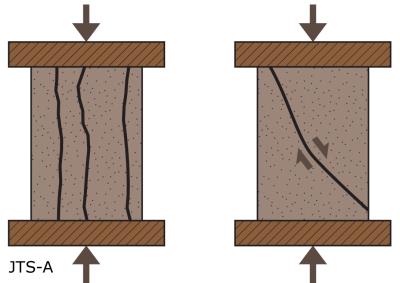 The difference is illustrated schematically in Figure JTS-A. In brief (and to vastly oversimplify), a brittle rock subject to compression can break either by jointing, wherein fractures form parallel to the direction of maximum compression, or by faulting, which involves breakage at acute angles to the direction of maximum compression, and slip along the surfaces thus formed. All else being equal, joints generally form at shallow crustal levels, and faults at deeper ones. Mineralized joints thus are commonly coated only with low-temperature minerals, for only rarely do they exist in the deeper realms where hot hydrothermal fluids circulate through the rocks to form a much wider range of exotic mineral species. At Franklin and Sterling Hill, the vast majority of the numerous hydrothermal mineral species that have made these localities famous occur along faults rather than joints (Verbeek, 2013).
Joints can form in minerals as well as rocks. Masses of brittle, exceedingly fine-grained minerals such as some sussexite and sphalerite are those most likely to contain them, but they can form as well in large grains of brittle minerals that lack cleavage (e.g., franklinite) or those with only poor cleavage (e.g., some willemite). Below we show some examples of joints in the local minerals. These are sometimes misinterpreted as cleavage and are the occasional cause of misidentification of mineral species as a result. Parting planes due to exsolution can also resemble joints but are wholly unrelated to them and are treated elsewhere.
Joints Images
